-Fr. Wilhelm Flieger, SVD. Welcome remarks as PPA President during the First National Convention of the PPA and General Assembly of the Health Research Network, February 3, 1993.
The Association of Demographers and Population Scientists in the Philippines.
Contemporary Fertility Decline: Myths and Realities by Dr. John B. Casterline, Ohio State University
Reactors: Dr. Alejandro N. Herrin, Research Triangle Institute International
Dr. Esperanza I. Cabral, United Nations Population Fund
Lifestyle and Health, Understanding HIV and AIDS, Assessment and Use of Census and Vital Registration Data, Sexuality and Reproductive Health Issues, Socio-economic Impacts of Climate Change and Other Natural Disasters, Population, Economic, and Environment Issues, Fertility and Poverty, Youth Issues

The Hopkins Population Center, on the occasion of its fortieth anniversary, and the Bill and Melinda Gates Institute for Population and Reproductive Health at Johns Hopkins invite you to watch a live webcast on Friday, October 14:
“The Seventh Billion Human: What Does This Birth Mean?”
As you may know, the United Nations projects that the seventh billion human will be born on October 31. We are holding a symposium on the consequences of this expected birth.
Date and time:
Friday, October 14, 2:00 – 4:00 PM Eastern US Time; 18:00 – 20:00 Greenwich Mean Time; 2.00 – 4.00 AM October 15, Philippine Time
Speakers:
* David Lam,
Professor, Department of Economics, University of Michigan, and President of the PAA
* Brian O’Neill,
National Center for Atmospheric Research
* Babatunde Osotimehin,
Executive Director, United Nations Population Fund
* Hania Zlotnik,
Director, Population Division, United Nations
The webcast will be available at: http://www.jhsph.edu/7billion
On-line viewers can submit questions with Twitter using the hash tag #JHSPH7B.
(The symposium can also be viewed at this address at a later time beginning about October 21.)
We hope that you will be able to watch the webcast.
And if you are in the area, you are invited to attend in person.
It will be held in:
Johns Hopkins Bloomberg School of Public Health
615 North Wolfe Street
Baltimore, MD 21205
Sheldon Hall, Room W1214
Best regards,
Andrew Cherlin, Director, Hopkins Population Center
Amy Tsui, Director, Bill and Melinda Gates Institute for Population and Reproductive Health
--
Hopkins Population Center
The Philippine Population Review is a peer-reviewed journal of the Philippine Population Association. It is featured in Philippine Journals Online (http://www.philjol.info) and in Ulrich’s Periodicals Directory (http://www.ulrichsweb.com).
The Review seeks to strengthen the evidence-based discourse of population issues confronting the national, international and global communities. It provides a forum for the conceptual, methodological and empirical quantitative and qualitative analyses of the vital events of human population—fertility, mortality, morbidity and migration—including their movements, interrelationships, complexities, consequences and impact. Its scientific information base is expected to help improve population and population-related policies, programs, teaching and research, towards enhancing the quality of life and well-being of all.
Manuscripts addressing any of the foregoing topics or themes may be considered for the Review’s next two issues. Please follow these instructions:
1. Authors should submit original manuscripts only. Whether a full length research article (5,000-6,000 words), a research note (2,000-3,000 words), or a book review (1,000-2,000 words), submitted manuscripts must not have been published nor being considered for publication elsewhere.
2. Submitted articles must bear the following information. The first page should contain the title of the manuscript, the names of the authors and their institutional affiliations and complete contact addresses. The subsequent pages should discuss the contents of the articles. For research articles, the contents should have the following parts:
a) abstract (with five keywords maximum),
b) introduction
c) methods
d) discussion
e) conclusion and
f) references.
Tables and figures should be embedded within the text, but these must be kept to a maximum of five. References should be prepared according to the standards set by the Publication Manual of the American Psychological Association 5th edition. Manuscripts must be double-spaced.
3. Manuscripts must be submitted via email to ppaphils@gmail.com. All submissions will be acknowledged. The review process takes up to three months. Once a manuscript is received, the editor reviews it for relevance, substance, rigor and organization. If deemed suitable, it is forwarded for peer review. Review results are immediately communicated to the authors. If the review outcome is “revise and resubmit,” the author/s is/are required to resubmit the manuscript one month upon receipt of the reviewer’s comments and suggested revisions.
CALL FOR PAPERS
The Philippine Population Association (PPA) is pleased to announce Annual Scientific Conference and General Assembly on 2-5 February 2011 in Cagayan de Oro City. The conference theme is “Towards A Critical and Responsive Engagement to Population Challenges.” We welcome submission of scientific papers from both PPA and non-PPA members on any of the following topics:
1. Ageing
2. Trends and Changes in Marital Relations
3. Gender and Sexuality
4. Impact of Natural Disaster
5. Women and Children in Conflict
6. Lifestyle and Health
7. Historical Demography
8. HIV/AIDS: Issues and Measurement
9. International Labor Migration
10. Population Displacement
11. Reproductive Health Issues among Indigenous Population
The PPA is now accepting submission of abstracts of no more than 300 words for evaluation by the Scientific Conference Committee for possible oral or poster presentation. The papers should focus on the Philippines. Inter-country comparisons will be considered as long as the Philippines is one of the countries. Papers submitted should not have been published or presented locally. We also encourage proposals from associations or groups for panel submission with a maximum of three papers per panel. Selected papers will be published in the Philippine Population Review.
A session on Historical Demography in the Philippines will be held. This session will present papers on historical demography in the Philippines with emphasis on mortality and morbidity in the 19th century.
Please email abstracts/panel proposals to ppaconference@gmail.com using the PPA 2011 Conference Abstract Submission Form. The deadline for submission of abstracts/panel proposals is 30 November 2010. Accepted papers/posters will be notified by 18 December 2010. Full papers of accepted papers should be submitted by 31 December 2010 for inclusion in the book of abstracts. Graduate students are encouraged to participate. Awards will be given to best papers.
PRE-CONFERENCE WORKSHOP/ORIENTATION
A one-day pre-conference workshop on Technical Writing and Data Analysis will also be conducted on 2 February 2011.
For more information, please visit the PPA website: http://www.ppaphils.org/,
http://www.ppaphils.blogspot.com/ or send email to ppaconference@gmail.com.
In view of requests for extension of deadline for submission of abstracts to the PPA Scientific Meeting in February to be held in Hotel Supreme, Baguio City, we are extending the deadline for submission of abstracts for possible presentation in the Meeting to 9 January 2009. Accepted papers/posters will be notified by 16 January 2009.
CALL FOR PAPERS
PPA Annual Scientific Conference
Hotel Supreme, Baguio City
5-6 February 2009
THEME: Population Movements: Global-Local Intersections
The Philippine Population Association will hold its 2009 Annual Scientific Conference with the theme Population Movements: Global-Local Intersections.
Population movements refer to geographic movements of people within national boundaries and across international borders. The conference will explore trends, patterns, differentials, determinants and consequences of population movements including but not limited to health, urbanization, development, and population structure.
We encourage submission of abstracts of no more than 500 words for evaluation by the Scientific Conference Committee for possible oral or poster presentation. Papers submitted for oral presentation should not have been published or presented elsewhere. We also encourage proposals for panels with a maximum of three papers per panel.
Non-PPA members are also invited to submit abstracts and panel proposals.

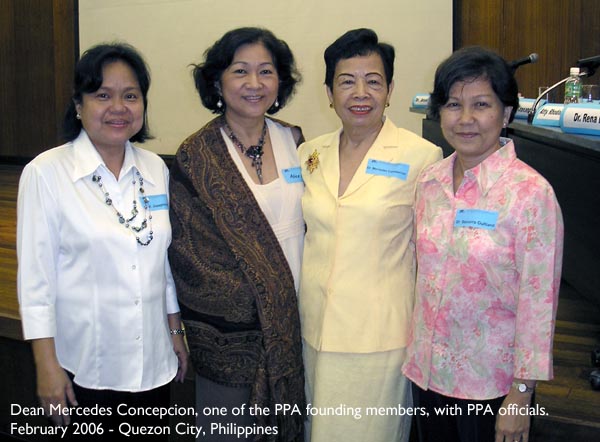
Professional associations usually start out with a handful of enthusiasts bonded by common professional interests and goals. The PPA was established in 1987, by a group of dynamic demographers. These individuals represented governmental as well as private centers from Luzon, Visayas, and Mindanao engaged in population and population-related studies.